
Language
Language
ROTEC KNOWLEDGE

Torsional Vibration Testing

Torsional vibration testing turns a suspected problem — unexplained noise, a fatigue crack, an unexpected NVH complaint — into hard data. This page explains what a torsional vibration test involves, what a typical test setup looks like, and how to get one done.

Discuss your project →
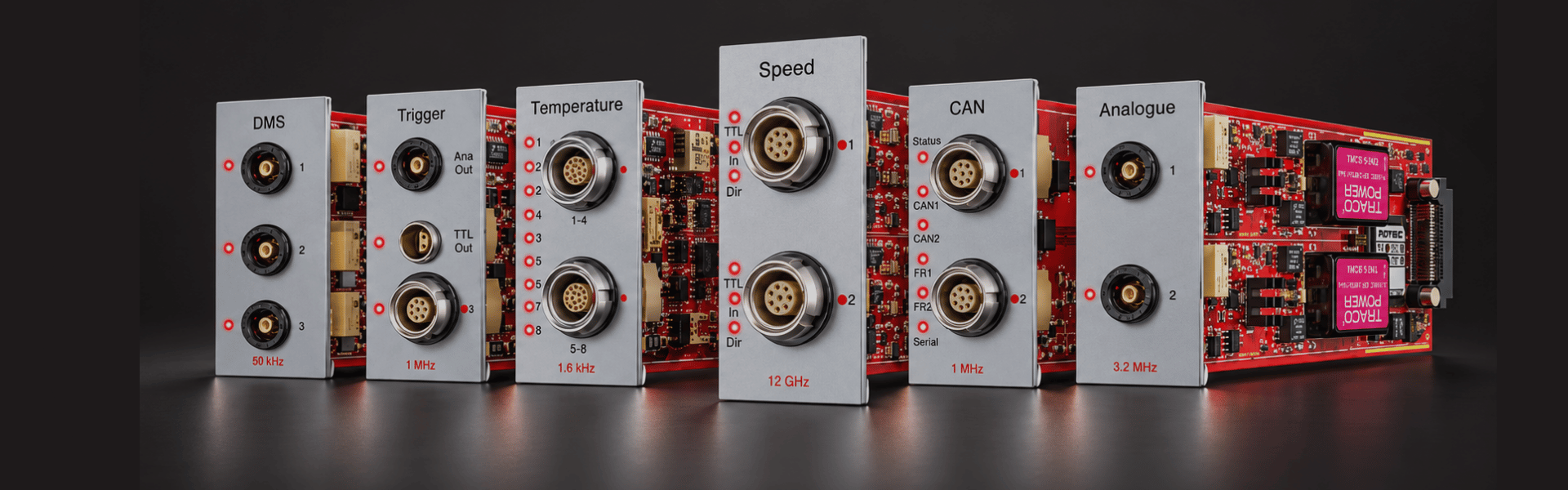
ROTEC RASdelta measurement system

What Torsional Vibration Testing Involves

A torsional vibration test captures how a shaft's rotational speed fluctuates across its full operating range — typically during a run-up test, where speed is swept from idle to maximum RPM while the measurement system records rotational speed variations continuously. Zooming into any short window of that run-up reveals the underlying oscillation: rapid speed fluctuations riding on top of the overall RPM trend, generated by torque pulses from combustion, gear meshing, or other rotating sources.

The goal of the test is to capture this behaviour with enough resolution and speed range coverage to identify:

Which torsional orders are present and how strong they are
Whether any order crosses a structural natural frequency (a resonance risk)
How amplitude changes with speed and load
Whether observed behaviour matches predictions from design or simulation

Typical Test Setup

A torsional vibration test system typically combines:

A speed sensor (magnetic pickup, optical encoder, or incremental encoder) mounted on the shaft — crankshaft, camshaft, turbine shaft, or gearbox input/output shaft, depending on the application
Sensor electronics to condition and clean the raw signal
A high-resolution measurement device, using speed input boards operating in the gigahertz range to achieve very fine angular resolution regardless of sensor tooth count
Analysis software to process the angle-domain data into orders, spectra, and diagnostic diagrams

For applications with additional dynamic requirements — such as valvetrain behaviour on fired engines — the same measurement philosophy extends to fast analogue channels (multi-megahertz sampling) alongside the speed reference, enabling synchronised analysis of multiple fast-moving components in a single test.

What You Get From a Torsional Vibration Test

A well-run test delivers more than a single number — it produces a set of diagnostic views engineers can act on directly:

Waterfall diagrams, showing how amplitude evolves across orders and speed
Contour diagrams, giving a fast visual overview of problem orders
Campbell diagrams, revealing where order lines cross natural frequencies — the classic signature of a resonance risk
Quantified seating, lift-off, or dynamic behaviour data for valvetrain-specific tests

These results feed directly into design decisions: adding or tuning dampers, revising gear or valvetrain geometry, or comparing the results with agreed technical assessment criteria.

Industries and Applications We Test

Industries and applications

  • Automotive and commercial-vehicle engines
  • Motorsport drivetrains
  • Marine and stationary diesel engines
  • Steam and gas turbines
  • Electric-vehicle drivetrains
  • Wind turbine gearboxes

Why test with ROTEC

Why Test With ROTEC

ROTEC's single-source approach covers the entire measurement chain — sensors, signal conditioning, high-resolution data acquisition, and post-processing analysis software — backed by decades of engineering experience across racing, road, and heavy-duty applications. That combination is what turns raw speed data into a reliable diagnosis, not just a chart.

Questions and answers

What does torsional vibration testing investigate?

Speed fluctuations and vibration amplitudes across the agreed speed and load range. The assessment can examine orders, indications of resonance and differences between operating points.

Which results can a test provide?

Depending on the test brief, outputs include order, waterfall, contour or Campbell diagrams and a technical assessment. Measurement scope and assessment criteria are agreed for the application.

Can ROTEC help with the test setup?

ROTEC ENGINEERING supports measurement-point design and sensor installation through to measurement, analysis and presentation of the results.

Discuss your measurement project

Discuss your measurement task, operating conditions and suitable analysis with ROTEC.

Discuss your project →

ROTEC KNOWLEDGE

Torsional Vibration Testing

Torsional vibration testing turns a suspected problem — unexplained noise, a fatigue crack, an unexpected NVH complaint — into hard data. This page explains what a torsional vibration test involves, what a typical test setup looks like, and how to get one done.

Discuss your project
ROTEC RASdelta measurement system

What Torsional Vibration Testing Involves

A torsional vibration test captures how a shaft's rotational speed fluctuates across its full operating range — typically during a run-up test, where speed is swept from idle to maximum RPM while the measurement system records rotational speed variations continuously. Zooming into any short window of that run-up reveals the underlying oscillation: rapid speed fluctuations riding on top of the overall RPM trend, generated by torque pulses from combustion, gear meshing, or other rotating sources.

The goal of the test is to capture this behaviour with enough resolution and speed range coverage to identify:

Which torsional orders are present and how strong they are
Whether any order crosses a structural natural frequency (a resonance risk)
How amplitude changes with speed and load
Whether observed behaviour matches predictions from design or simulation

Typical Test Setup

A torsional vibration test system typically combines:

A speed sensor (magnetic pickup, optical encoder, or incremental encoder) mounted on the shaft — crankshaft, camshaft, turbine shaft, or gearbox input/output shaft, depending on the application
Sensor electronics to condition and clean the raw signal
A high-resolution measurement device, using speed input boards operating in the gigahertz range to achieve very fine angular resolution regardless of sensor tooth count
Analysis software to process the angle-domain data into orders, spectra, and diagnostic diagrams

For applications with additional dynamic requirements — such as valvetrain behaviour on fired engines — the same measurement philosophy extends to fast analogue channels (multi-megahertz sampling) alongside the speed reference, enabling synchronised analysis of multiple fast-moving components in a single test.

What You Get From a Torsional Vibration Test

A well-run test delivers more than a single number — it produces a set of diagnostic views engineers can act on directly:

Waterfall diagrams, showing how amplitude evolves across orders and speed
Contour diagrams, giving a fast visual overview of problem orders
Campbell diagrams, revealing where order lines cross natural frequencies — the classic signature of a resonance risk
Quantified seating, lift-off, or dynamic behaviour data for valvetrain-specific tests

These results feed directly into design decisions: adding or tuning dampers, revising gear or valvetrain geometry, or comparing the results with agreed technical assessment criteria.

Industries and Applications We Test

Industries and applications

  • Automotive and commercial-vehicle engines
  • Motorsport drivetrains
  • Marine and stationary diesel engines
  • Steam and gas turbines
  • Electric-vehicle drivetrains
  • Wind turbine gearboxes

Why test with ROTEC

Why Test With ROTEC

ROTEC's single-source approach covers the entire measurement chain — sensors, signal conditioning, high-resolution data acquisition, and post-processing analysis software — backed by decades of engineering experience across racing, road, and heavy-duty applications. That combination is what turns raw speed data into a reliable diagnosis, not just a chart.

Questions and answers

What does torsional vibration testing investigate?

Speed fluctuations and vibration amplitudes across the agreed speed and load range. The assessment can examine orders, indications of resonance and differences between operating points.

Which results can a test provide?

Depending on the test brief, outputs include order, waterfall, contour or Campbell diagrams and a technical assessment. Measurement scope and assessment criteria are agreed for the application.

Can ROTEC help with the test setup?

ROTEC ENGINEERING supports measurement-point design and sensor installation through to measurement, analysis and presentation of the results.

Discuss your measurement project

Discuss your measurement task, operating conditions and suitable analysis with ROTEC.

Discuss your project

Explore the topic

Skip to main content
Modulare Messwerterfassung im Studio-1
Synchrone Analogdatenerfassung bis 3,2 MHz

Die präziseste Drehzahlmessung der Welt

 with Synchronous Analog Data Acquisition up to 3.2 MHz. 
Marine Engineering
Independent Propulsion Shaft Measurement

Marine Engineering

World Wide Network
International

Sales & Partner Network

RAS-Software
Keine Programmierkenntnisse erforderlich.

Analysesoftware

Allianz Arena
Seit 1988

Made in Germany

Plug and play –  Formula 1
Sensorik, Signalkonditionierung und Datenerfassung aus einer Hand.

Plug and play – Drehzahlmesstechnik

35+ Jahre Erfahrung
1.500+ installierte Systeme weltweit
47 Länder mit betreuten Kunden
12,3 GHz Zeitauflösung der Zählerkarte
IHRE TECHNISCHE HERAUSFORDERUNG

Welche Frage soll Ihre Messung beantworten?

Präzise Ergebnisse entstehen durch das Zusammenspiel von Sensorik, Signalaufbereitung, Datenerfassung, Analyse und technischem Systemverständnis.

Drehschwingungen

Torsionsdämpfer, Kupplungen, Riemen- und Kettentriebe bis zum kompletten Antriebsstrang. 

Ventildynamik

Ventiltriebe analysieren und optimieren – vom geschleppten Zylinderkopf bis zum befeuerten Motor. 

Übertragungsfehler

Zahnradpaare und Getriebe in Entwicklung, Prüfstand und End-of-Line präzise untersuchen.

Dauerüberwachung

Turbinen, Generatoren und Antriebe kontinuierlich und zustandsorientiert überwachen. 
Anwendungen

Bewährt in anspruchsvollen Einsatzbereich

Getriebe

Verbrennungsmotor

NVH, Komfort und Emissionen gezielt analysieren und optimieren.

Verbrennungsmotor

  • Steuertrieb, Nebenaggregate, Kupplung und Dämpfer, Getriebe sowie Ventildynamik werden gezielt analysiert, um das dynamische Verhalten des Verbrennungsmotors ganzheitlich zu verstehen. 

Dampfturbine

Energieerzeugung

Übertragungsfehler, Drehschwingungen, Körperschall und Resonanzen gezielt erfassen und bewerten.

Energieerzeugung

  • Windkraftgetriebe und Turbinen werden unter realen Betriebsbedingungen analysiert, um dynamische Auffälligkeiten frühzeitig zu erkennen und technische Zusammenhänge zuverlässig zu bewerten.
Elektromotor

E-Fahrzeug

NVH, E-Antrieb und Akustik im Gesamtsystem bewerten.

E-Fahrzeug

  • Hybrid- und ICE-Fahrzeuge, E-Antriebsstränge und E-Achsantriebe werden gezielt untersucht, um Schwingungen, Geräusche und das dynamische Verhalten des Antriebssystems zu verstehen und zu optimieren. 
Zahnrad

Maschinenbau

Getriebeprüfung, Wälzgetriebe und Geräuschoptimierung präzise analysieren.

Maschinenbau

  • Einflankenwälzprüfung und die Analyse von Wälzgetrieben ermöglichen eine präzise Bewertung von Übertragungsverhalten, Geräuschentwicklung und dynamischen Auffälligkeiten. 
DIE KOMPLETTE MESSKETTE

Präzise Ergebnisse beginnen mit der richtigen Messkette.

Präzise Ergebnisse entstehen durch das Zusammenspiel von Sensorik, Signalaufbereitung, Datenerfassung, Analyse und technischem Systemverständnis.

Messkette_Magnetsensor_1_komp-1

Sensorik

Die Grundlage jedes präzisen Messsignals.
Passende Sensorik und präzise Applikation schaffen die Voraussetzung für zuverlässige Messdaten und belastbare Analysen. 
Messkette_Magnetsensor_2_komp-1

Signalaufbereitung

Aus Sensorsignalen werden zuverlässig auswertbare Messsignale.
Eine präzise Signalaufbereitung reduziert Störeinflüsse und stellt sicher, dass relevante Informationen sauber und zuverlässig an die Datenerfassung weitergegeben werden.
Messkette_Magnetsensor_3_komp-1

RASdelta Datenerfassung

Hochpräzise und synchronisierte Messdatenerfassung.
RASdelta erfasst Messsignale präzise und synchron und schafft damit die zuverlässige Datengrundlage für die anschließende Analyse. 
Messkette_Magnetsensor_4_komp-1

RAS Software

Messdaten verstehen, Zusammenhänge erkennen.
Die RAS Software visualisiert und analysiert die erfassten Messdaten und macht relevante dynamische Zusammenhänge und Auffälligkeiten sichtbar. 
undefined

Engineering Insights

Von Messdaten zu belastbaren technischen Entscheidungen.
Unsere Engineering-Expertise verbindet Messdaten, Systemverständnis und Erfahrung zu klaren Bewertungen und konkreten Handlungsempfehlungen.
Rotec China Office nimmt offiziell den Betrieb auf-featured-image

Rotec China Office nimmt offiziell den Betrieb auf

Click to view Rotec China Office nimmt offiziell den Betrieb auf
Rotec Munich setzt seinen internationalen Wachstumskurs konsequent fort: Das neue ROTEC China Office hat...

Warum Rotec Munich wieder Rotec Munich heißt-featured-image

Warum Rotec Munich wieder Rotec Munich heißt

Click to view Warum Rotec Munich wieder Rotec Munich heißt
Seit September 2025 firmiert VISPIRON ROTEC wieder unter dem Namen Rotec Munich. Die Rückkehr zum...
Übertragungsfehler in Windkraftgetrieben messen | Rotec Munich-featured-image

Übertragungsfehler in Windkraftgetrieben messen | Rotec Munich

Click to view Übertragungsfehler in Windkraftgetrieben messen | Rotec Munich
Übertragungsfehler: Die unsichtbare Herausforderung moderner Windkraftgetriebe Windenergie zählt heute zu den...
ROTEC Kunden Wissensdatenbank online-featured-image

ROTEC Kunden Wissensdatenbank online

Click to view ROTEC Kunden Wissensdatenbank online
München, 03. Januar 2025 – ROTEC stellt ab sofort eine neue Online Wissensdatenbank zur Verfügung, um...
KLINGELNBERG AG erwirbt Messtechnik-Spezialisten ROTEC-featured-image

KLINGELNBERG AG erwirbt Messtechnik-Spezialisten ROTEC

Click to view KLINGELNBERG AG erwirbt Messtechnik-Spezialisten ROTEC
Zürich/München, 02. September 2024 – Die KLINGELNBERG AG, ein Unternehmen der KLINGELNBERG Gruppe (SIX:...
ROTEC übernimmt Auswerteeinheit für Ventiltrieb-Messungen von Sensitec-featured-image

ROTEC übernimmt Auswerteeinheit für Ventiltrieb-Messungen von Sensitec

Click to view ROTEC übernimmt Auswerteeinheit für Ventiltrieb-Messungen von Sensitec
Die ROTEC Munich GmbH übernimmt exklusiv die Herstellung und den Vertrieb der Multi Channel Box von Sensitec,...